Additional Blog Posts Regarding Mezcal Can Be Found Here:
If the article topics do not readily appear on the right side for clicking, simply scroll down to the bottom of this page for a list of article themes, then click on what interests you and the article should appear.
Pulque in Santiago Matatlán: A Five Generation Family Pedigree
Alvin Starkman M.A., J.D.
It was still dark, early morning, when Abrahám Cortés Garcia was out in the field harvesting aguamiel, the “honey water” used to produce the naturally fermented drink known as pulque (POOL – kay). He usually awoke at about 5 a.m., and either did the 20 minute walk to his field on his own, or stopped by son Lorenzo’s home to ask him to come along. He might even pick up a neighborhood mozo, a young helper. At 77 years old, Abrahám was showing no sign of slowing down, a stunning revelation since later in the day he still had to do his other chores both around the house and in the fields, and then just before dusk collect aguamiel for a second time.
That was Don Abraham’s daily routine when I met him two decades ago, and when I first began accompanying him, alone or with Lorenzo. They and others who harvest aguamiel, are known as tlachiqueros. At the time, wife Victoria Hernández Mateo was approaching 80, and while her sight and hearing had both begun to fail, she nevertheless was able to play her part in the family business, filtering the aguamiel, ensuring that she had both the aguamiel and pulque of at least two grades of fermentation available for sale – both to neighbors and other townspeople, and for wholesale to the odd vendor who would buy for resale in Oaxaca, or in village marketplaces outside of hometown Santiago Matatlán.
Santiago Matatlán is in the southern Mexico state of Oaxaca, about an hour’s drive from the capital, Oaxaca de Juárez. Matatlán is one of the oldest colonial settlements in all of Mexico, founded in 1525, only a few years after the arrival of Cortés’ army. But the crowning glory of the town is its reputation as the World Capital of Mezcal. In 1980 the town boasted about 360 palenques, that is, small family owned and operated distilleries or fábricas de mezcal (the number has greatly diminished since then). However, by most accounts it’s pulque, and not mezcal, with the most colorful and documented history dating to pre-Hispanic times.
Evidence suggests that the Spanish learned distillation from the Moors, and then imported rudimentary methods to The New World. Thus mezcal production may have begun at this time, in the 1500s, based upon this historical evidence. However, we also know that later in the 16th century Filipinos arrived on the West coast of Mexico, and began importing coconuts and other foodstuffs which would remain staples in the country for generations. The Filipinos also knew how to distill. And, more recently, compelling evidence has been uncovered to suggest that distillation in the country began some 2,500 years ago. But the preponderance of proof indicates that fermenting the sweet liquid, aguamiel, drawn from the core of certain varieties of agave generally known as pulqueros, had been a pre-Hispanic tradition, perhaps dating back 3,000 – 4,000 years. There were ritualistic ceremonies often associated with its presentation to village elders and high priests, and imbibing.
Mezcal is produced from the heart or piña of most often other varieties of agave, after being baked, then crushed, fermented, and finally distilled. Pulque, by contrast, is the fermented aguamiel of very specific species of agave. Once the plant has matured, after anywhere between 15 and 20 years of growth, the aguamiel is harvested from the center of the succulent. There’s no baking, no crushing, and no distilling.
Lorenzo is the eldest of Victoria’s and now deceased Abrahám’s six children. Lorenzo is married with four children, as well as grandchildren. On that early morning two decades ago, Lorenzo and his father were fortunate to have me and my research assistant drive them to the fields. They were lucky because it had rained most of the night, meaning that the dirt pathways were much more difficult to navigate on foot than usual, with shoes sticking in the mud.
It was still pitch black out, but knowing their way was not an issue, since on hundreds of prior occasions Abrahám and Lorenzo had walked those same paths between rows of agave, nopal cactus, and freshly ploughed furrows awaiting the sowing of corn kernels. Elsewhere in the countryside other plots of family land are worked for cultivating mainly black beans and garbanzo, in an effort for villagers to maintain nutritional self-sufficiency.
For collecting aguamiel, Abrahám and Lorenzo brought along their simple yet effective tools of the trade. There’s the ten-liter plastic receptacle (to others more commonly thought of as a gas can or jerrican); a length of rubber hose fastened to the neck of a 2.5 liter plastic Coca-Cola bottle with a hole at the bottom, and a slightly concave razor-sharp one-piece metal raspador, that is a 4-5 inch diameter tool with a short handle. Previously they had used a long gourd with a hole at each end rather than the makeshift adapted Coke bottle for sucking the aguamiel from the plant. But if a gourd falls, it can easily break, so Abraham invented the Coke bottle alternative.
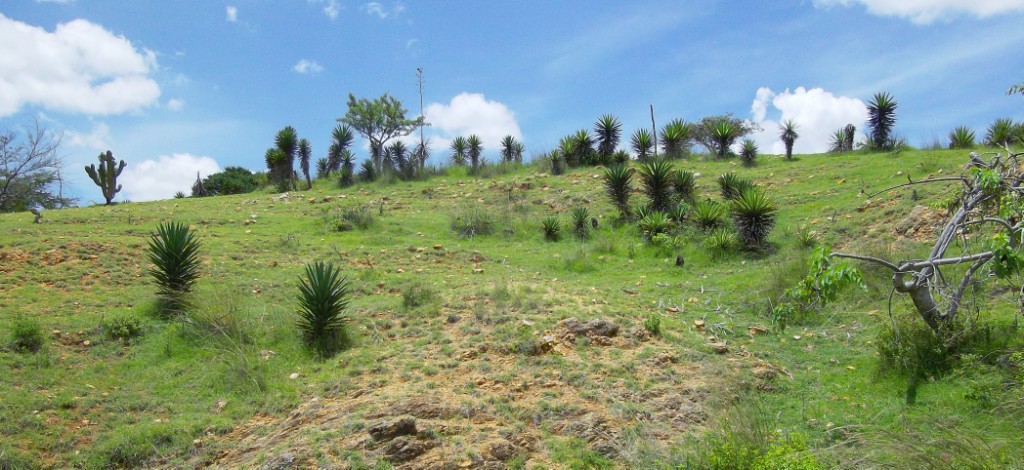
The pulquero agave most commonly used to extract the aguamiel in the central valleys of Oaxaca, scientific name Agave americana americana, is one of the more majestic and attractive succulents one ever encounters. At maturity it’s often ten feet tall, and six or more feet in diameter, counting the outer reaches of its curled blue-green leaves (pencas), each of which has a slightly raised design on both sides. Because of the needle-sharp tip and series of thorn-like pricks forming the edges of each penca, precaution must be taken before harvesting begins. [As an aside, because I am not totally adept at planting and harvesting agave, at the end of the day when I am working my own field, I usually return home rather bloodied.]
At maturity, a stalk known as a quiote shoots up. Just before its appearance, the center leaves are cut down with a machete. A specially forged and sharpened iron tool is then employed to carve out a well in the center of the plant from where the quiote would otherwise emerge. The well is typically 12-18 inches deep, and at the beginning of the harvest a few inches in diameter. The plant is often left for at least a week prior to the commencement of “tapping.” Several pencas are sheared off, while others are gingerly bent over backwards, the spiny tip inserted into and through a lower leaf. This reduces the likelihood of injury once harvesting aguamiel begins.
We walked through the mud, each step seemingly more difficult than the last. Abrahám and Lorenzo were far ahead, knowing exactly where they would work this early morning. They were anxious to begin, and then finish harvesting from several of their 400 or so plants which were at different stages of growth. Darkness enhanced the tranquility; the air was fresh after the night’s rain; moon beams shone on the agave enhancing their natural brilliance.
Abrahám approached a pulquero, then ever so carefully reached in and removed strategically placed thorny bush branches; then a hand-hewn wooden top about ten inches in diameter; followed by a piece of cloth, then a smaller wooden lid, and finally a sling-shot shaped piece of wood, revealing the plant’s inner sanctum.
In his broken Spanish Abrahám enlightened:
“You see that blackish colored liquid, that’s water, not aguamiel; we have to get that water out from last night’s rain, before reaching the aguamiel. The “Y” shaped piece of wood straddles the well hole so that the little top stays in place and doesn’t fall in. The cloth keeps bees and other insects from getting at the aguamiel. The larger top actually has to be nudged into place between the leaves; it keeps them from bending forward and encroaching on the open well area. Then I put those spiny branches on top of everything. They keep the animals, especially possums, from getting at the well during the night. When we finish with each plant this morning I won’t have to put the branches and the rest back on top because the possums only come out at night, and I have to come back in the late afternoon for the second harvest. Then I’ll put them back. Even though I use the two tops, and the cloth, see how the water has managed to sneak in.”
Aguamiel is harvested twice daily; in the early hours of the morning, and again at the end of the day, the final chore before a late evening dinner. Abrahám would obtain an average of four to five liters of aguamiel per harvest, with luck 10 liters a day, depending on the size of plant, when it matured, and the particular terroir. The agave is typically tapped in this way for 3-4 months. When it rains, less aguamiel is produced because the water displaces the hollow inside the well, the result being that less aguamiel can seep through the plant and into the well.
Lorenzo appeared content to hand his father the tools as he is asked for them, still an apprentice in the eyes of dad. He will have finally gotten it right when his father would be no longer able to do the harvest. He handed Abrahám the hose-Coke bottle contraption. Abrahám sucked from a small hole in the bottom of the bottle, to get the water out of the well and into the tubing. He poured the rainwater on the ground, and then repeated the task. Finally he had reached the milky aguamiel, so this time the liquid was sucked from the hose into the plastic bottle, following which it was directed into the jerrican. Extracting the aguamiel would be repeated until the last drop had been suctioned from the well.
Using the raspador at the end of each harvest is the key to being able to obtain the maximum aguamiel the plant is able to yield at the next harvest 10-12 hours later. Abrahám scraped a thin layer of fleshy fiber from the inside of the well. Touching it can give you a rash, so care must be taken when scraping from inside the well; however chickens seem to enjoy eating it. The cloth and wooden pieces would then be carefully placed in and on top of the well, in appropriate sequence, before proceeding to the next plant.
Lorenzo and his father moved on to another plant; not the one beside the first, but elsewhere, Abrahám knowing exactly where to find the next plant to be worked. He occasionally pointed Lorenzo in the right direction. The routine would be repeated several times that morning.
Hard work is deserving of reward. It was about 8 a.m., and all things considered the harvest had gone reasonably well, given that it was rainy season, with three or four liters of aguamiel collected. Abrahám pulled a small soft drink bottle from his pocket, together with a tiny half gourd. We each had a couple of shots of mezcal before heading back to the house.
Late that afternoon, while Abrahám was back in the fields with his team of oxen preparing the earth for planting corn, Doña Victoria was holding court with a few of her neighbors, one of whom translated from Zapoteco to Spanish:
“Let me get you some pulque, but wait, it’s pretty strong. Do you think you can tolerate it?”
It’s all part of the process, using pulque from a previous batch as a starter for this morning’s aguamiel. The goal is to adjust the percentage alcohol to achieve the desired punch, using the science of time and temperature, and of course knowing one’s market – who will come by when, for how much, and what degree of fermentation they will want.
The culture of diplomacy in Oaxaca dictates that one does not lightly speak of the inferior quality of the product of the competition. I was able to glean only that there is a handful of pulque producing families in Matatlán, some of whom may cut corners and use commercial additives including sugar. I’ve now visited most of them, and dare not, ever, discuss the pulque of others, with them. It’s the same subtle gossip that occurs within the mezcal industry amongst Oaxaca’s rural producers: “our product is the real deal, 100% natural;” or, “she sells pulque in the markets, but she doesn’t grow agave, and doesn’t do the work that we do – she just buys from us, and from anyone else she chooses, and resells.”
Whether trying pulque made by the campesino who awakens before the rooster so as to harvest aguamiel before the sun begins to beat down, or purchasing in the markets, there’s a distinct difference from the pasteurized pulque produced for the commercial marketplace, and the real deal. I had hoped that when the time would come, Abraham’s tradition would continue, with perhaps Lorenzo following in his father’s footsteps, or another family member taking the reins.
As it turned out, one of Lorenzo’s children, Reina, who had been living in Mexico City, made the decision in consultation with the family, to return to Santiago Matatlán once her grandparents Abrahám and Victoria had become too elderly and frail to totally
manage on their own. She has become the main family member entrusted with the harvesting of aguamiel, and placed in charge of sales and marketing of aguamiel, pulque, and their derivatives of curados (pulque blended usually with seasonal fruit) and tepache (strong pulque mixed with a little honey and piloncillo [a sugar cane derivative akin to compacted brown sugar]). She is the fifth generation of tlachiquero in the family. There is little doubt that Reina will continue the family tradition for decades to come.
Alvin Starkman periodically takes clients on his mezcal tours (www.mezcaleudcationaltours.com) into the fields with Reina, to harvest aguamiel at the conclusion of a mezcal educational excursion.


 RSS Feed
